
Desire is defined by audacious neon tones and graceful feminine figures in Fran Williams’s exhibition, Heartbreaks, at Franz Kaka. Williams portrays desire as a fluid, ever-changing force that flows and reforms. We naturally possess and frequently utilize desire, and it can take many forms as it materializes itself in our aspirations, and in turn, affirms our existence. Desire is presented as a malleable extension of ourselves, shaping itself into our work, emotions, and actions. Therefore, Williams’s concept of desire is a self-reflective will to action.
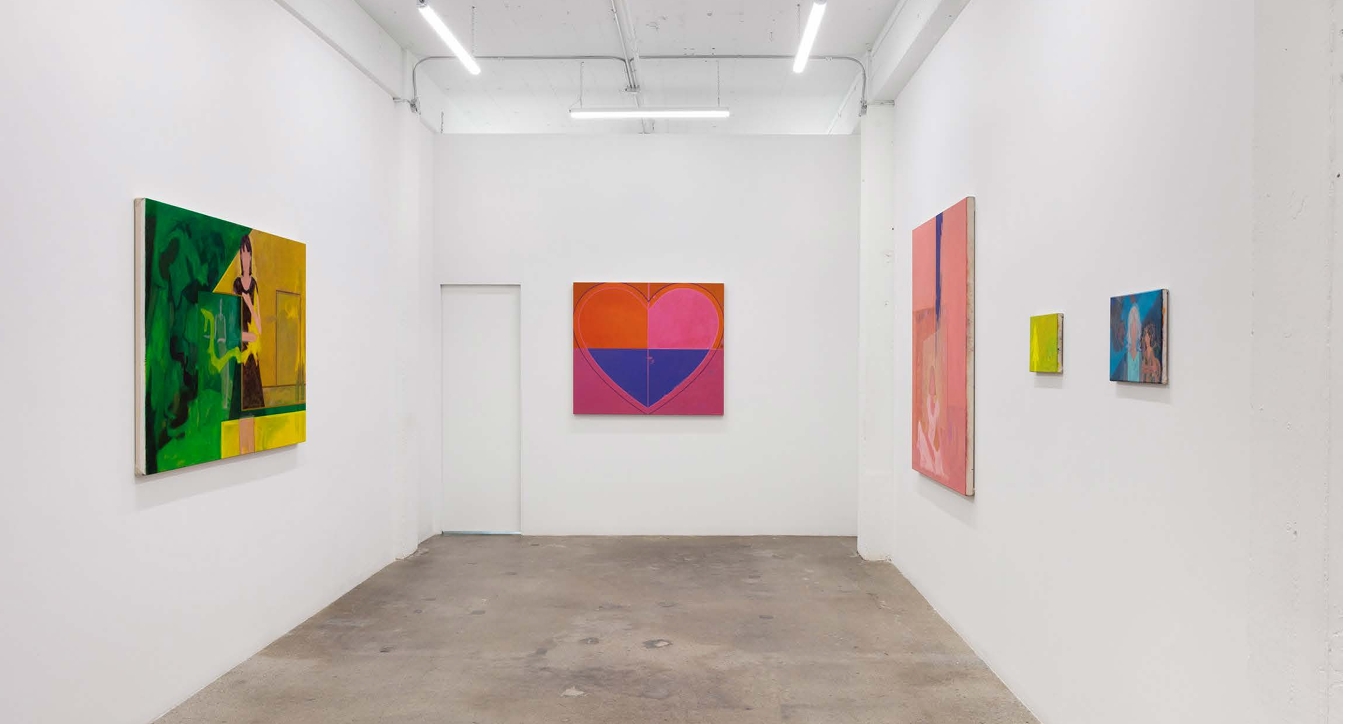
Installation view of Fran Williams, Heartbreaks at Franz Kaka, 2025.
Williams’s contrasting composition portrays the spectrum of femininity. The opposition created by the artist’s use of bold colours and delicate subjects ultimately culminates in the “eternal girl,” an ideal of femininity that lies at the centre of Williams’s paintings. The “eternal girl” serves as a point of recognition and tension; the juxtaposition of her petite and vulnerably positioned physique against a large canvas, along with short yet conservative dresses and stylized hair that frames an impersonal face, underscores abstract ideas and characteristics that embody the stereotypical ideal of femininity that the world continues to uphold.
At the opening night, I had various conversations throughout the evening where viewers contended with their own reading of the exhibition, sparking various interpretations of the concept of the “eternal girl.” Art critic Tatum Dooley made a clever comparison to the complex, yet deeply relatable women in Sofia Coppola’s films, likening the “eternal girl” to the Lisbon sisters in The Virgin Suicides and Marie Antoinette. On the other hand, Sam Alkan, a fellow student and writer, compared the character to the artist herself, sensing that the “eternal girl” must be a reflective outlet for her own experiences with femininity.
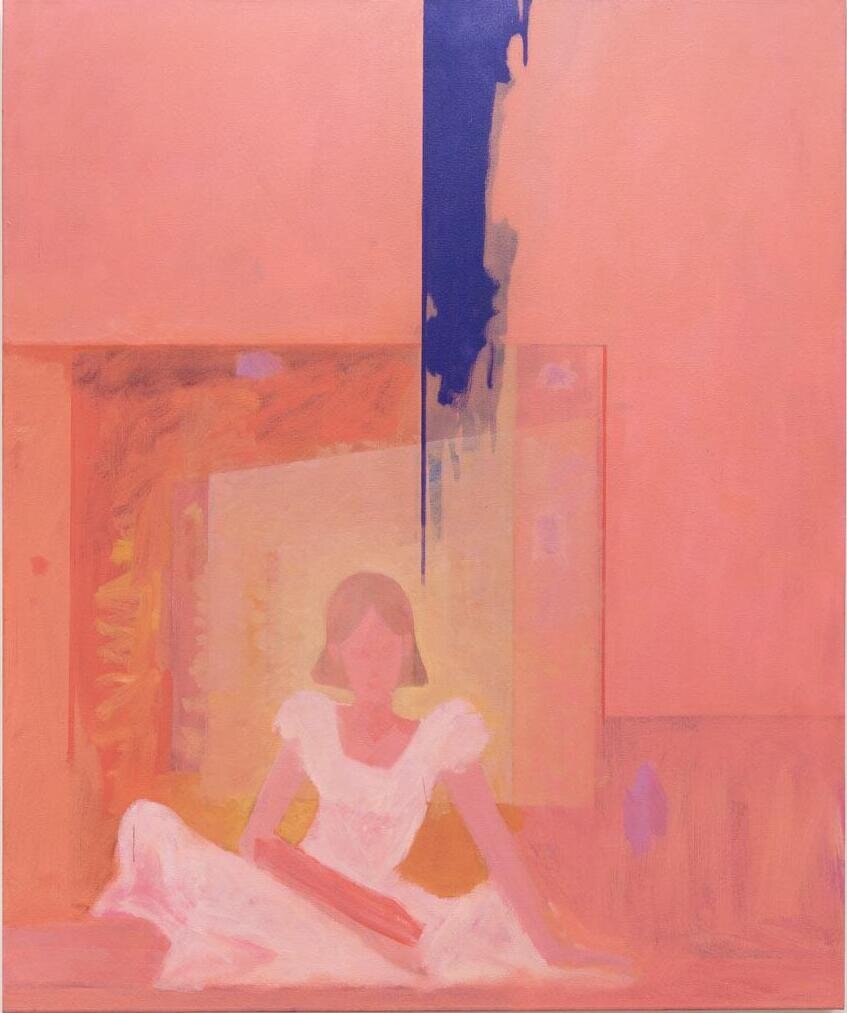
Fran Williams, Pftjschute!, 2025, oil on canvas, 59.25 x 49 in.
From my perspective, the “eternal girl” may be understood as a Platonic concept, as her balanced stance on the spectrum embodies the highest form of femininity in the realm of ideals. The rest of us in the material world, that is, on earth, hold a smaller aspect of this ideal within ourselves, as we ourselves are extensions of the ideal by our relation and experience to femininity. This allows us to gain some understanding of this abstract form. Still, we differentiate from this ideal and its world through our own individual characteristics, making the “eternal girl” a transcendental and visceral abstract of womanhood.
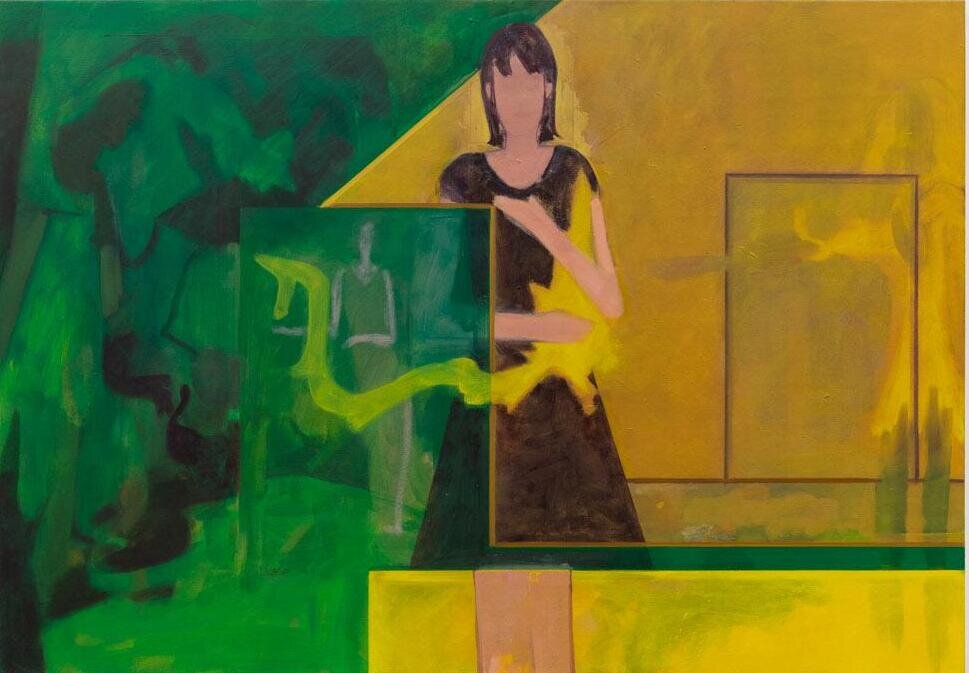
Fran Williams, crave&home / retrieval, 2025, oil on canvas, 42 x 60 in.
In cave&home / retrieval, the concept of desire is depicted through an “eternal girl” who is depicted alongside her artistic work, illustrating the direct connection between herself and her desire to create. That connection is represented by the yellow energy extending from her heart, binding her and her work as one. This piece embodies Williams’s literal definition of a “heartbreak” as a heart that breaks solely to release one’s will to act to fulfill one’s desires. Thus, for the artist, a “heartbreak” serves as the starting point of our desire’s extension into the world. We carry desire in our hearts only for them to break, liquefy, and ultimately reshape into an expression of ourselves in whatever way we choose to materialize it in the world.
cave&home / retrieval captures the process of creating art, making a meta-reference to the artist’s own process. The process is documented in what may be interpreted as a timeline, moving from left to right. It begins on the green-tinted portion of the canvas, where a woman sits diligently at work, bent over a desk, possibly creating the painting that the “eternal girl” in the center of the work holds. On the right, a faint figure, possibly in the yet unset future, faces a wall. Following in the story, she may be hanging the artwork, marking the end of her desire-driven process of creation. The scene is illuminated by a cheerful, yellow light that acknowledges its radical difference to the bold, dark green; this contrast represents the extreme ends of the feminine spectrum as angst and delicacy.
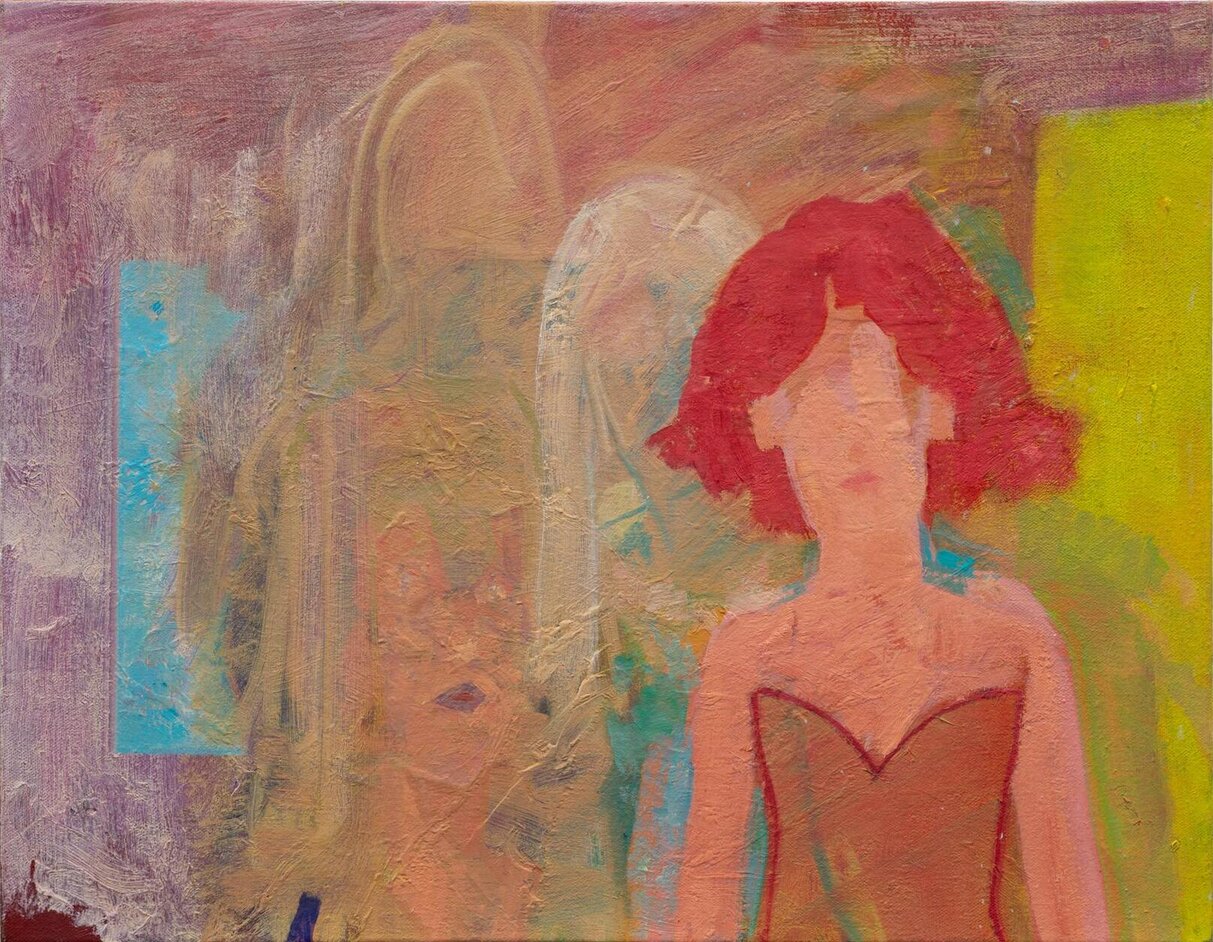
Fran Williams, Em, 2025, oil on canvas, 14 x 18 in.
Desire and femininity differ in definition and concept; however, Williams underscores how both align in their elements of contrast and abstraction. Desire is an abstraction of our will, a force of energy; it is unseen but felt. Its contrast lies in its materialization in the real world, through which we act as the medium, as the painting cave&home / retrieval demonstrates. Femininity, as the “eternal girl” embodies, has an abstract yet visceral connection to women. Its contrast lies in its ends of bold angst and sweet grace, as Williams’s use of colour also illustrates.
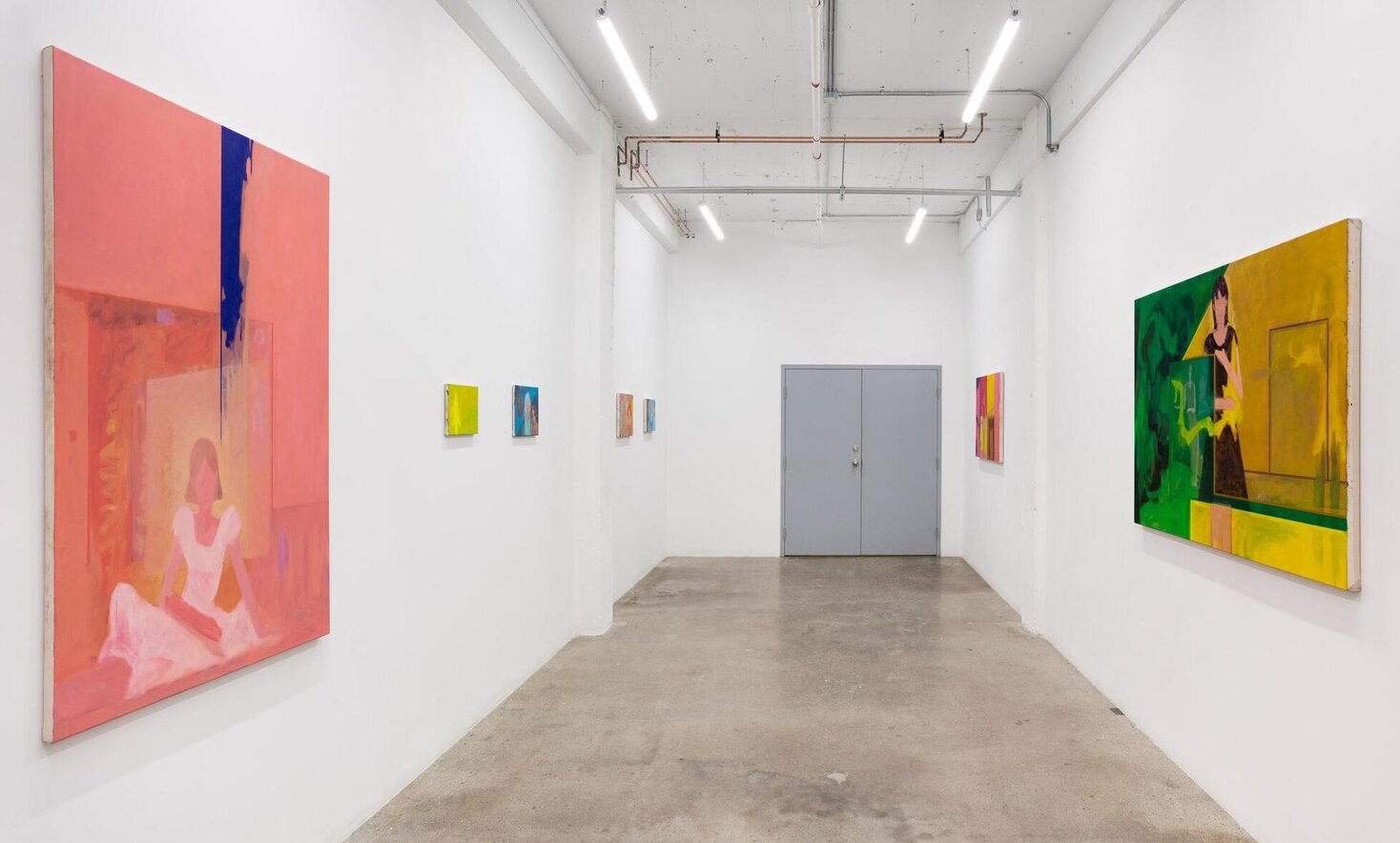
Installation view of Fran Williams, Heartbreaks at Franz Kaka, 2025.
I invite the reader to attend Fran Williams’s Heartbreaks at the Franz Kaka Gallery to personally engage with these thought-provoking pieces.
Antonella Pecora Ruiz
Images are courtesy of Franz Kaka.
*Exhibition information: Fran Williams, Heartbreaks, May 30 – June 28, 2025, Franz Kaka, 1485 Dupont St. #208, Toronto (access at 300 Campbell Ave). Gallery hours: Thursday – Saturday 12 – 5 pm.